
Zoho consulting for Miami teams managing customers across systems and markets
Remote implementation and integration for Miami-area businesses. The engagement defines delivery responsibilities, meeting windows and any location-specific requirements.
When an account has several contacts, delivery locations or commercial relationships, a simple contact list stops being enough. Sales needs a clear view of the opportunity. Finance needs dependable billing information. Operations needs to know what was agreed. FI Digital helps build the CRM and integration work that connects those responsibilities.
For Miami distributors and service businesses, our starting point is the customer journey: where information arrives, who owns it and which decision depends on it. We can implement a new Zoho process, repair an existing configuration or assess a connection to another application.
A regional focus with a clear operational purpose
Miami-Dade County identifies international trade and logistics as important parts of its economy. Our proposed focus is businesses managing relationships across suppliers, customers, branches or distribution partners. The useful opportunity is better control of those relationships, not a promise that a CRM resolves every cross-border requirement.
We work through the information model before building automations. A customer group, an individual contact, a billing entity and a delivery location may be related, but they are not interchangeable. If the system treats them as the same thing, routing and reporting can become unreliable as the business grows.
Separate the account, the transaction and the report
Use three questions to assess the current design. At account level, who is the customer and who can approve a commercial decision? At transaction level, which entity issued the quotation or invoice, in which currency and under whose responsibility? At reporting level, which definition allows management to compare activity without double counting?
| Level | Question |
|---|---|
| Account | Who is the customer and who can approve a commercial decision? |
| Transaction | Which entity issued the quotation or invoice, in which currency and under whose responsibility? |
| Reporting | Which definition allows management to compare activity without double counting? |
Those questions form a practical scoping worksheet. Record the owner and source of truth for each answer. The worksheet can expose why a dashboard total differs from finance even when neither team has entered an obviously incorrect number.
Currency handling, tax treatment and commercial rules require explicit decisions. We configure approved business requirements and test their implementation. Your finance or legal advisers remain responsible for the advice that determines those requirements; a software implementation is not a substitute for that review.
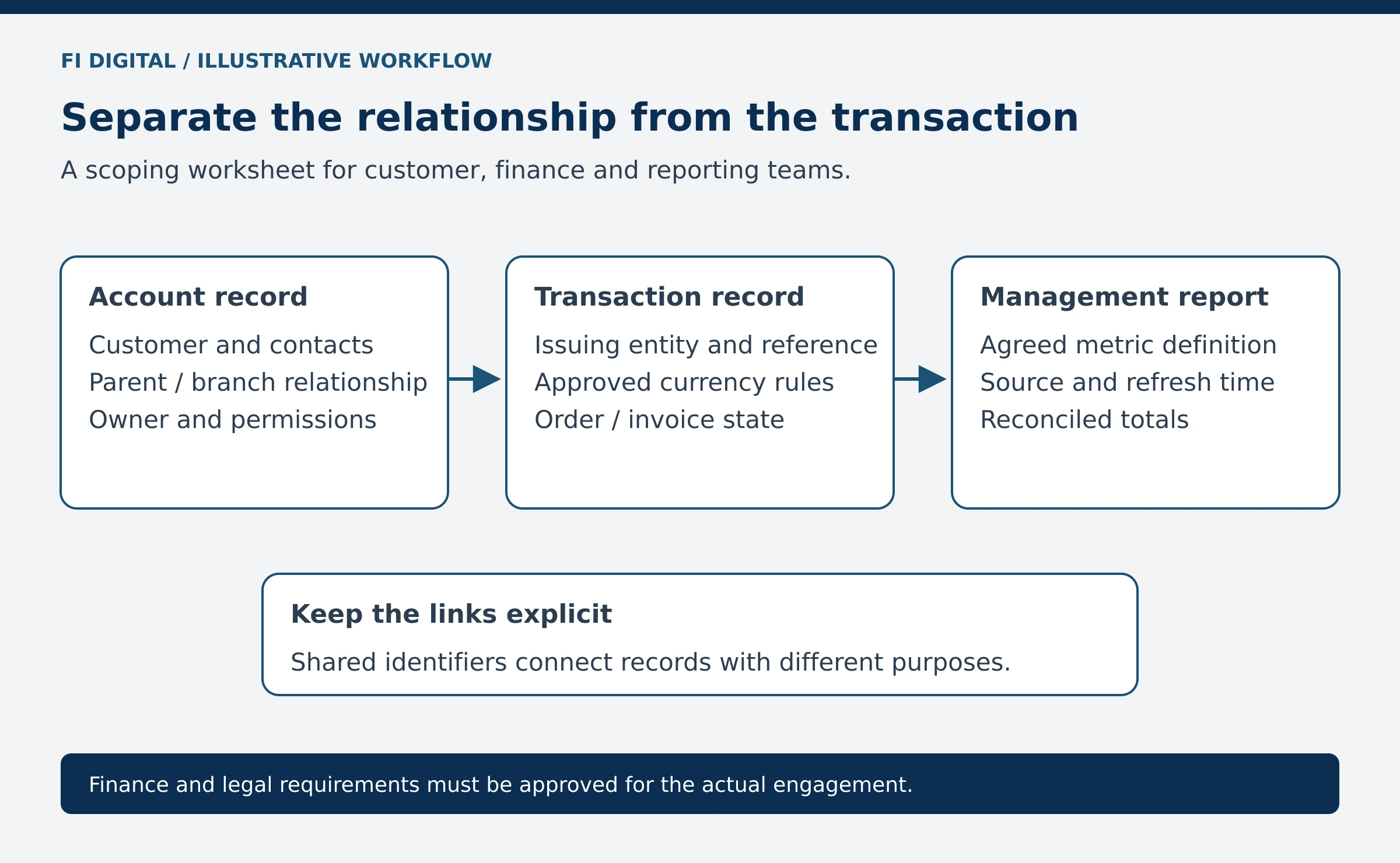
Separate the relationship from the transaction
A scoping worksheet for customer, finance and reporting teams.
Finance and legal requirements must be approved for the actual engagement.
An illustrative distributor workflow
Consider an inquiry for a product range already sold through several channels. Sales needs to identify whether the buyer belongs to an existing account, whether a territory owner should handle it and which information is needed before preparing a quotation. A service question arriving later should remain connected to the same relationship.
A proposed Zoho design could bring account ownership, opportunity status and service history together. An integration could expose selected order or invoice information from another system. Permissions would determine which team can view or change each record, and unresolved exceptions would have an owner.
This is an illustrative workflow, not a completed Miami client project. The useful first release would be defined with your team and tested against actual operating scenarios, including duplicates, reassigned accounts and failed transfers.
Keep working finance systems where they fit
You do not need to replace a functioning accounting platform simply to improve CRM visibility. Zoho publishes a native QuickBooks integration; we would assess that and other supported options before proposing custom development. Availability, edition, data-center support and required behavior must be checked for your actual environment.
The important work is often the mapping and operating rules around the connector. Which system creates the customer? What prevents a duplicate? How are corrections handled after an invoice is issued? Who sees a sync failure, and how is it resolved without creating another transaction?
Where a supported connection meets the need, use it. Where a documented gap remains, compare a scoped extension with the cost of maintaining a custom integration. Technical possibility alone does not establish the most economical approach.
Repair weak adoption and unreliable reporting
An underused CRM may need fewer changes than expected. We review the work users perform, which fields they actually need and where the process sends them back to email or spreadsheets. The resulting backlog should connect each change to a business problem and a testable outcome.
For management reporting, agree definitions before designing charts. An open opportunity, a confirmed order and a paid invoice represent different stages. The dashboard should make those distinctions clear and show when its source information was last refreshed.
International experience relevant to the problem
FI Digital's Australian automotive work connected an OEM with 232 dealerships through a custom solution built on Zoho Catalyst. It addressed website lead transfers, status visibility and dealership-originated lead reporting across multiple CRM systems. The rollout took two months, with transfers occurring in seconds.
The client reported at least three hours saved weekly for the OEM team and about one hour per dealership per week. This is Australian delivery evidence. It is not a Miami client reference, a result forecast or an assurance that your system interfaces provide the same access.
A remote engagement your team can plan around
We agree meeting windows in Eastern Time, the people responsible for business decisions and the route for questions between workshops. Language requirements must be discussed explicitly; this page does not promise Spanish-language delivery. Any on-site workshop is assessed separately.
The scope should state configuration, migration, integration, testing, training and handover responsibilities. It should also identify subscriptions and ongoing services outside the implementation fee. Describe the relationship or handoff your current setup makes difficult, and we can discuss a practical first step.
Frequently asked questions
Do you provide Zoho consulting for Miami remotely?
Yes. This page describes remote delivery for Miami-area businesses, with meeting windows and responsibilities agreed before work begins. It does not claim a Miami office or included local attendance. If your procurement process requires on-site workshops or a particular contracting arrangement, raise that requirement during the initial scoping discussion.
Can you support our South Florida branches together?
A shared process can be assessed across branches while retaining the permissions and ownership rules each location needs. We would review account relationships, local responsibilities and the reports management expects. The solution should make shared information usable without automatically giving every branch access to every record or assuming identical operating practices.
Do you provide Spanish-language implementation?
Language requirements need explicit confirmation during scoping. This page does not promise Spanish-language workshops, documentation or support. We can assess the languages required for users, customer communications and project delivery, then identify which capabilities are available and which need an approved translation or specialist arrangement before a commitment is made.
Can Zoho work alongside QuickBooks?
Zoho publishes a native QuickBooks integration, and we assess supported options before proposing a custom connector. The exact suitability depends on your editions, environment and workflow. Testing should cover customer matching, record ownership, corrections and failed synchronization, rather than treating the availability of an integration as proof that every required scenario is covered.
Will the system handle international tax compliance?
The implementation can reflect requirements approved by your finance and legal advisers, but software configuration does not itself establish cross-border tax compliance. We need clear decisions about entities, currencies, transaction handling and records. Those responsibilities and any specialist review should be documented before the system is accepted for production use.
Can you clean up an existing Zoho implementation?
Yes. A review can examine duplicate accounts, unclear ownership, unreliable reports and integrations that require repeated manual correction. We prioritize fixes by their operating impact and dependencies. The output should explain what to change, what to retain and how users will confirm that the repaired process works in their daily activity.
Do you have a Miami client result we can review?
No permissioned Miami result is claimed on this page. The Australian OEM example is identified by its actual geography and reported scope. Relevant international experience can support a technical discussion, but it should not be presented as local proof or used to guarantee the same outcome for your organization.
What should our first implementation phase cover?
Choose a complete, useful journey such as inquiry to assigned opportunity or an approved sales-to-finance handoff. Include the necessary data preparation, permissions, exception handling and user training. Agree the acceptance measures before building, then use the first release to decide whether expanding the scope is justified by the operational result.