

Find out why your Zoho setup is making work harder
Missed lead assignments. Reports that do not agree. Automations nobody wants to change because no one is sure what they will break. A Zoho health check gives your team a structured way to identify the causes and decide what to fix first.
FI Digital reviews the configuration, data and integrations around a defined business problem. The output is a practical repair plan with priorities, dependencies and acceptance criteria. You can use that plan to scope delivery, organize internal work or assess whether a wider redesign is justified.

Start with the failure people experience
We begin with examples from the operating team. Which request missed its owner? Which report required a manual correction? Which update reached one system but not another? The review follows those examples through the process instead of treating a long list of settings as evidence of a useful diagnosis.
The scope identifies the applications and workflows included. CRM, Desk, Books, Creator, Analytics and external integrations may have different owners and constraints. A clear boundary helps the review reach a usable conclusion without turning every unrelated request into part of the same engagement.
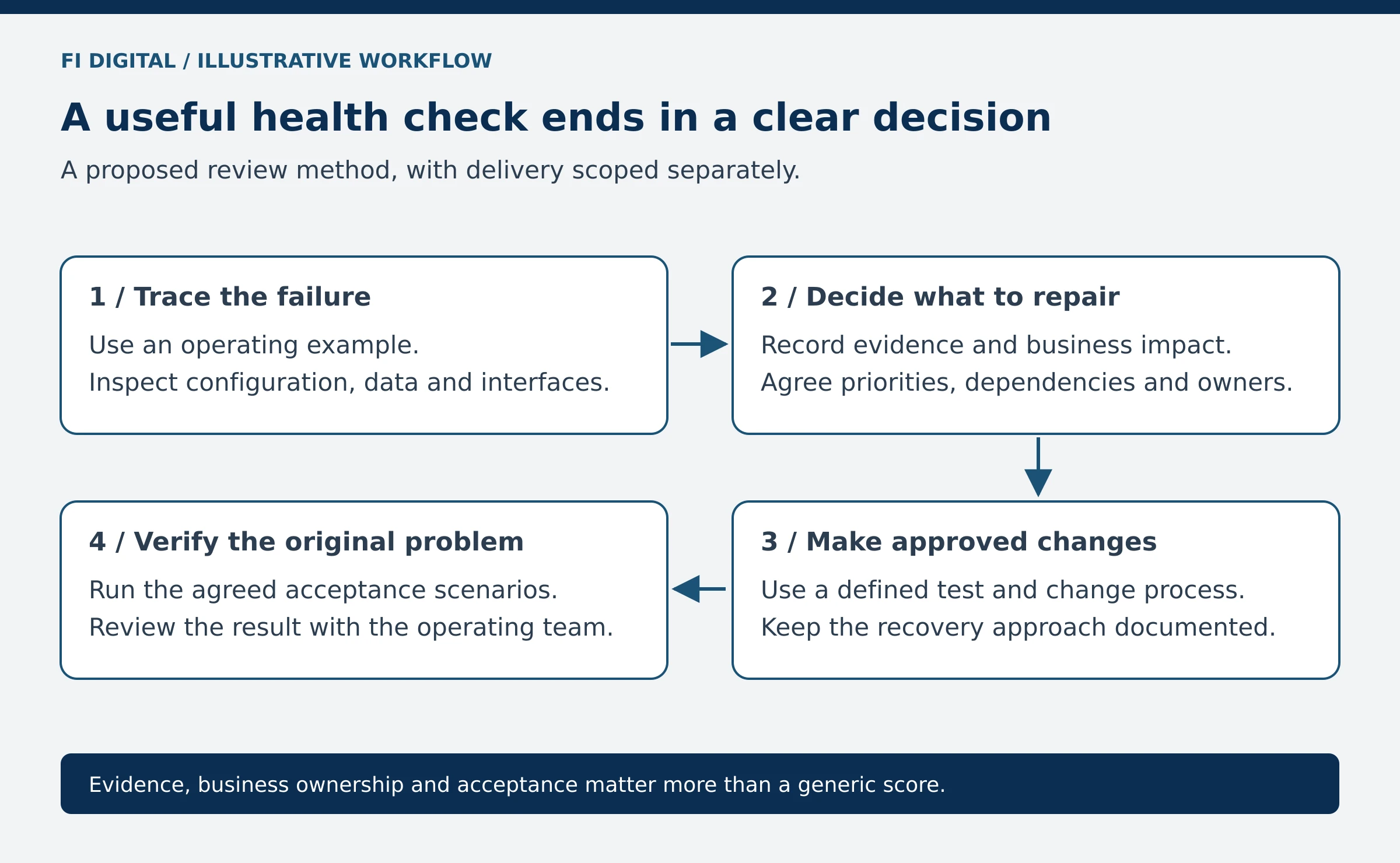
A useful health check ends in a clear decision
A proposed review method, with delivery scoped separately.
Evidence, business ownership and acceptance matter more than a generic score.
Examine configuration, data and ownership together
Configuration review considers assignment rules, permissions, workflows, custom functions and the order in which actions occur. Data review examines identifiers, duplicates, incomplete records and definitions used in reporting. Integration review follows authentication, mapping, update direction and recovery when a transfer fails.
We also ask who owns the process. A technically correct rule can still produce the wrong result if sales and operations use different definitions of an accepted opportunity. The review separates decisions the business must make from changes an administrator or developer can implement.
Access is agreed in advance and limited to the review's purpose. Credentials and confidential exports should not be sent through the website inquiry form. Where representative examples are needed, use an approved method and limit the information to what the review requires.
Receive a backlog the business can use
Each finding should describe the observed problem, supporting evidence, likely cause, business impact and proposed next action. The backlog identifies dependencies and the person needed to approve a change. Unknowns remain visible rather than becoming untested technical assumptions.
Priorities reflect the operating impact. A repeated failure that leaves customer inquiries unassigned may deserve attention before a cosmetic change. A report used for management decisions may need a reconciled definition before anyone redesigns its dashboard. The sequence should explain why a particular repair comes first.
Test the repair against the original problem
Acceptance scenarios turn a recommendation into something observable. For an assignment issue, test the expected owner, an exception and a repeated submission. For an integration, test successful delivery, a failure and safe recovery. For reporting, reconcile a defined sample to the agreed source records.
Where delivery is commissioned, work through an approved change process and an appropriate test environment. Record what changed and how it can be reversed if the release does not behave as expected. Users should confirm that the repaired process solves the problem they originally raised.
Decide what happens after the review
Some organizations can implement the recommendations internally. Others need a scoped repair project, specialist integration work or ongoing administration. Those are separate decisions with their own deliverables and responsibilities. A review should not require replacing the entire platform or buying a managed-service plan.
The value of the exercise is a clearer decision about the system you already own. Tell us which recurring failure is consuming the most attention, and we can discuss the applications, evidence and people needed for a focused review.
Frequently asked questions
What does a Zoho health check include?
The agreed scope can cover configuration, permissions, data quality, custom functions, integrations and management reports around a defined workflow. We also examine ownership and acceptance expectations. The deliverable is a documented set of findings and priorities, with evidence and next actions, rather than a generic score that hides unresolved questions.
Is this the same as ongoing Zoho support?
No. A health check is a bounded review that helps decide what needs to change. Ongoing support covers agreed administration, incidents or enhancements over time. The review may identify a need for support, but that is a separate commercial decision with its own responsibilities, capacity and service commitments.
Can you rescue an implementation another supplier started?
We can assess an existing implementation where the necessary access, documentation and permissions are available. The review establishes what is usable, what is incomplete and which dependencies remain unresolved. A rescue scope should follow that evidence; it should not assume the previous configuration must all be removed or promise a result before inspection.
Will you make changes during the assessment?
The assessment scope should specify whether it is read-only or includes approved corrective work. Production changes require a defined authorization and testing process. A discovery observation is not permission to alter live behavior, and urgent fixes should still have an owner, a record of the change and an appropriate recovery approach.
How do you prioritize the findings?
We consider business impact, frequency, dependencies and the consequences of leaving the issue unresolved. The backlog should distinguish a customer-facing failure from a minor usability request and identify decisions needed from your team. Priorities are agreed with the business owner so implementation effort follows the problems that matter most.
Can our own administrator use the repair plan?
Yes. The findings and acceptance criteria can be used by an internal administrator or another delivery team. Ask for the documentation format and expected detail in the scope. If a recommendation depends on specialist development or an external provider, that dependency should be explicit so your team can plan the next step.
Does the review certify that our system is compliant?
No. This service reviews operational configuration and implementation issues within the agreed scope. It is not a legal opinion, security certification or assurance that every regulatory obligation has been met. If specialist compliance or security assessment is required, identify it separately and involve the appropriately qualified reviewer before relying on that conclusion.
What information do you need to estimate the review?
Provide the application list, number of relevant workflows, known integrations and a short description of recurring failures. Existing documentation and the availability of business owners affect the scope. Start without passwords or confidential exports; the access method, evidence requirements and commercial terms can be agreed after the initial discussion.